Gel embeding
Guide for gel embeding
Gel embedding procedure:
Gel embedding
Procedures for tissue clearing and gel embedding.
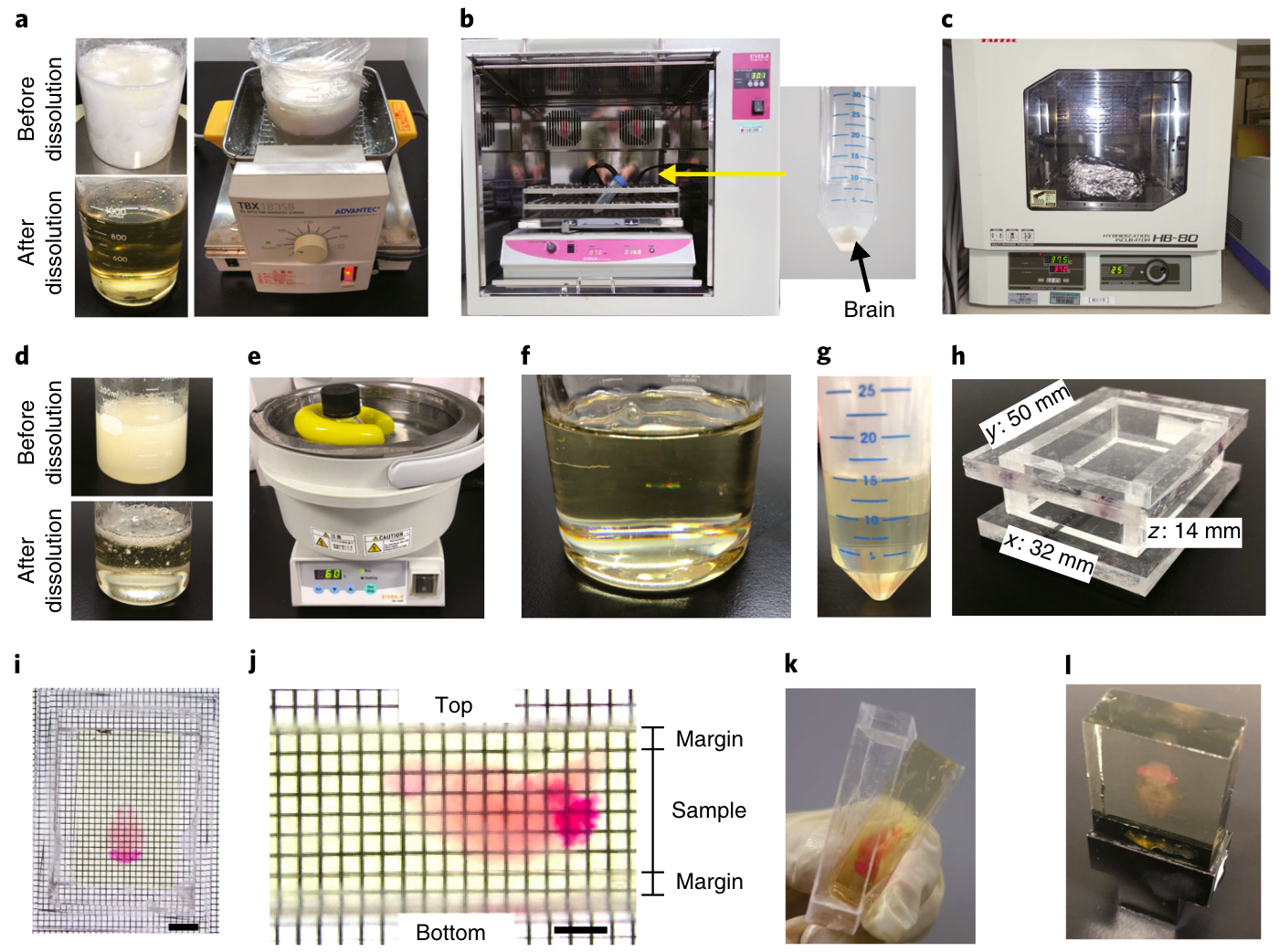
- a, Preparation of CUBIC-R+. This reagent can be easily dissolved by mild heating and stirring.
- b,c, An incubator with a shaker (b) and a hybridization incubator (c) that we use for steps requiring temperature control for the clearing procedure; inset shows tube containing brain.
- d, Preparation of 2% agarose–CUBIC solution. Agarose can be dissolved by repeated heating using a microwave and shaking.
- e, A water bath for the degassing step.
- f, 2% agarose–CUBIC solution after the degassing step.
- g, The sample is immersed in 2% agarose–CUBIC solution before gelation.
- h, A mold for gelation. It is designed for mouse brain.
- i, x–y view after gelation. Scale bar, 10 mm.
- j, y–z view after gelation. Scale bar, 5 mm. A margin of 1 mm or more is recommended on the top and bottom of the sample.
- k, Removing the sample gel from the mold.
- l, Fixation of the gel on the customized sample holder. All experiments followed the relevant governmental and institutional guidelines for animal experiments.
Gel embedding video
ref: riken.jp
Steps:
Filtering of CUBIC-R (used for clearing)
Add agarose (2%?)
Mix with vortex
Heating with microwave
Further mix with vortex
Repeat heating and vortex until complete dissolution)
Keep warming with water bath at 60˚C
Cover gel mold with parafilm
Prepare the first layer at 45˚C
Remove bubbles and dust
Cool down 1st layer to 4˚C for gelation
Embedding the sample in the 2nd layer (keep worming at 45˚C)
Blend the sample in the CUBIC-R/agarose
Place sample over the 1st layer
Fully embbed the sample in CUBIC-R/agarose 2nd layer
Remove bubbles and dusts
Cool down 2nd layer to 4˚C for gelation
Prepare the 3rd layer at 45˚C
Remove bubbles and dusts
Make flat plane with slide glass
Protect form light
Recover the gel from the mold
Inmerse in CUBIC-R for storage and equilibration (the precipitates will be dissolved in CUBIC-R)
…